The Microplastic Files · File 01
How much plastic has your
toothbrush released?
Yes, plastic toothbrushes release microplastics as the bristles wear. A 2025 peer-reviewed study estimated at least 2.33 million particles per person, per year, from toothbrush use under lab-simulated brushing. Most of it goes down the sink.
Put in your age to see what that adds up to over a lifetime of brushing.
Each dot stands for about 250,000 particles. Not to scale: most of these particles are smaller than the width of a hair.
Your estimate
plastic particles released over 35 years of brushing, based on one published study scenario.
This is an estimate scaled up from a lab study, not a measurement of you.
Show the working
Copies a link to your result.
Does a toothbrush need to be plastic?
We didn't think so. For hundreds of years toothbrushes were made from animal hair and wood or bone. Nylon bristles only arrived in 1938, and plastic has been the norm ever since.
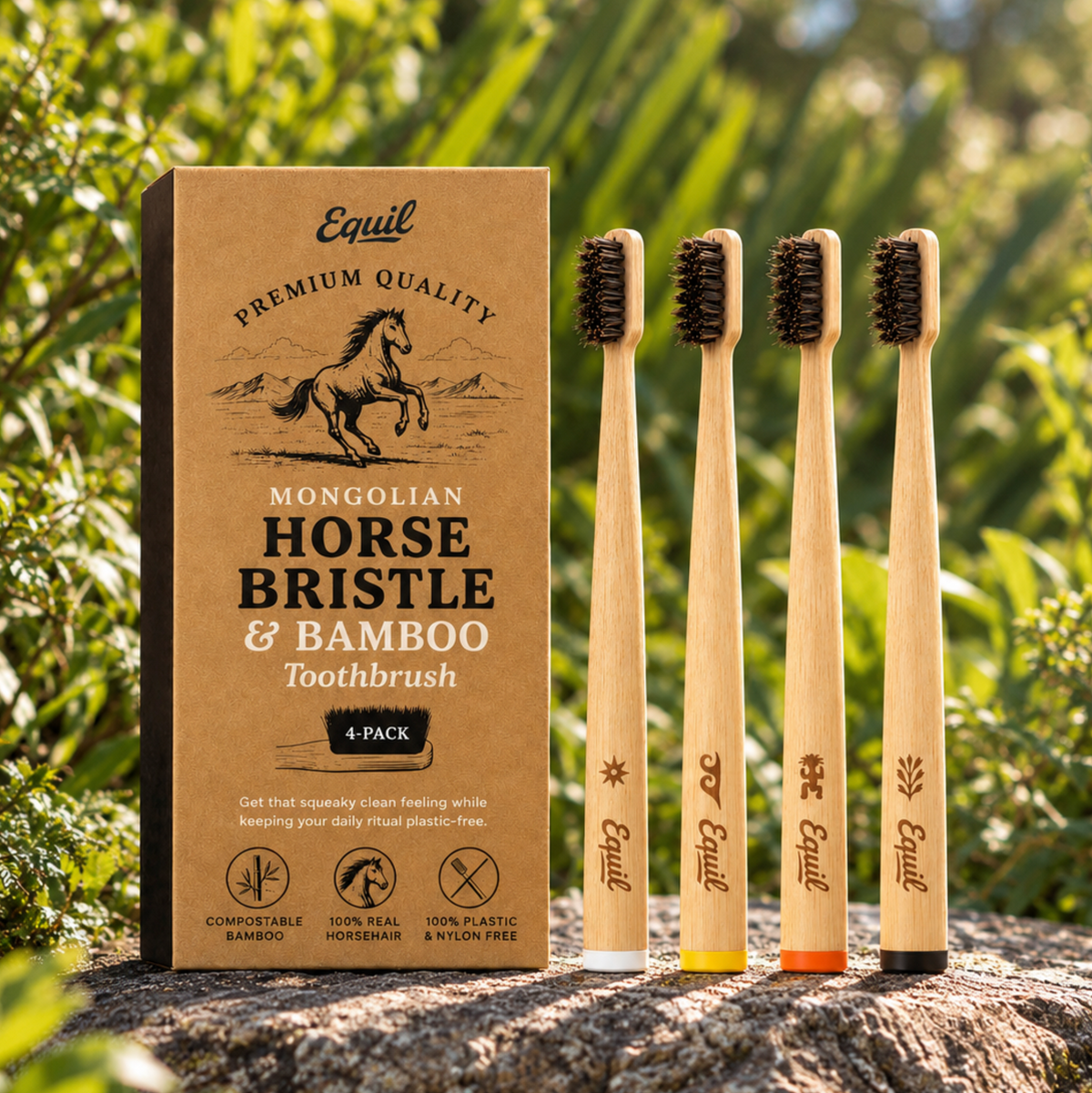
Ours goes back to the original: real horsehair bristles in a bamboo handle. No nylon, no glue. When it's worn out, snap the head off and compost the handle.
→ Explore the plastic-free toothbrushHow we worked it out
The calculator uses one figure: at least 2.33 million particles per person, per year, from toothbrush use. It's the headline estimate from Wang et al. (2025), published in Ecotoxicology and Environmental Safety.
What the researchers did
They brushed porcelain model teeth in artificial saliva with toothbrushes bought in China, using standard brushing (two minutes, once or twice a day) over a simulated three months, a toothbrush's normal life. They filtered the rinse water and counted the plastic particles under a microscope. Particles came from the bristles, and most were smaller than 0.1 mm. Release went up as the bristles wore.
How we use it
Your years of brushing with a plastic toothbrush, multiplied by 2.33 million. That's it. We don't adjust for brush type, brushing habits or the toothpaste you use.
What to keep in mind
- It's one study, in a lab, using toothbrushes sold in China. Real brushing varies.
- The yearly figure is the authors' estimate built on their survey of how people in China brush. It isn't a measurement of any one person.
- Toothpaste can contain microplastics too. The study looked at that separately and we've left it out.
Source: Wang S, Zheng N, Peng L, An Q, Chen C, Wei Y. Patterns and risks of microplastic release during primary oral care in Chinese residents. Ecotoxicology and Environmental Safety 302 (2025): 118694. doi.org/10.1016/j.ecoenv.2025.118694
Last reviewed: 25 November 2026. Spotted a mistake? Email hello@equil.co.nz and we'll fix it.